
India and China on Monday ended their standoff in Dokalam by withdrawing their troops from the area, just days before Prime Minister Narendra Modi's visit to China to attend the BRICS summit next week.

India has so many relationships, such an ability to communicate and find touch points with different countries and regions.

Raking up the border issue, Congress leader Rahul Gandhi on Friday said every individual in Ladakh knows that China has "taken away our land" and claimed that Prime Minister Narendra Modi's assertion that not an inch of land was taken away was "absolutely false".

The Minister of State for Commerce and Industry said there was a need of for promoting trade and investment as it is necessary for economic growth and sustainable development.

China reiterated that no meaningful dialogue can be held with India until it "unconditionally" withdraws troops from the disputed Doklam area and said Foreign Minister Wang Yi has authoritatively made Beijing's position clear on the issue.

After participating in the BRICS-BIMSTEC Outreach Summit in Goa, Myanmarese leader Daw Aung San Suu Kyi arrived in Delhi for an official three-day trip to India.

Ahead of his crucial talks with Russian President Vladimir Putin in Moscow, Chinese President Xi Jinping said on Monday that his peace plan to end the raging Ukraine war takes into account the 'legitimate' concerns of all parties and reflects the broadest common understanding of the international community.

"There are multiple reasons for the current food crisis, primarily because of recent cyclones in Bangladesh and Myanmar, which destroyed the entire rice crops in these countries, also exporters of rice. Now they have to import rice instead of exporting it," External Affairs Minister Pranab Mukherjee said during the deliberations on the issue at the ministerial meet in Yekaterinburg (Russia).

From early indications, the Modi government's foreign policy seems to be pragmatic and reciprocal, says K G Suresh.
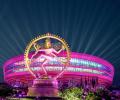
It is for China to decide what role it plays at the G20 summit in New Delhi, a top US official has said, asserting that if Beijing wants to come in and be a "spoiler", that option is available to it.
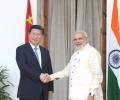
The Modi-Xi meeting assumes significance as India-China relations have followed a southward trajectory over contentious issues.

Policy of continuity won't help India earn business or respect, says Pramod Kumar Buravalli.

Prime Minister Narendra Modi will focus on extended neighbourhood, particularly the ASEAN and Central Asian regions, says Archis Mohan

China and India on Wednesday held their upgraded strategic dialogue to shore up bilateral ties amid hectic parleys to resolve differences over Beijing's reluctance to support India's bid for Nuclear Suppliers Group membership as well as a United Nations ban on JeM chief Masood Azhar.

A total of over 75 Heads of State and Foreign Ministers will be meeting with Modi, external affairs minister S Jaishankar and minister of state for external affairs V Muraleedharan during the week across various platforms.
The Modi PMO is like none other: It is staffed by people who are so low profile that the only dominant personality is the Prime Minister's.
'India needs to closely monitor the discussions at the UNSC and make counter-measures as this touches its core interests', points out Srikanth Kondapalli.

Colombo seems to be veering to the middle path between China and the US on global matters, but in regional matters of strategic security, it is increasingly identifying with India, points out N Sathiya Moorthy.

Modi will meet Xi at 12.30 pm (10 am IST).

Modi, who will be addressing the General Debate for the first time in five years, has a packed bilateral and multilateral agenda beginning September 23 till September 27.

The new government needs to clearly insist on diplomatic reciprocal arrangements with China. While reciprocity is a function of power in bilateral relations, the Modi-led government's responses should be based on India'S inherent strengths, says China expert Srikanth Kondapalli.

Prime Minister Narendra Modi on Wednesday thanked President Vladimir Putin for Russia's help and support in India's fight against Covid-19 as the two leaders agreed to establish a "2+2 ministerial dialogue" between foreign and defence ministers to add further momentum to the bilateral strategic partnership.

'Pleasure to meet FM Sergey Lavrov, this time in person. Excellent talks that reflect our Special and Privileged Strategic Partnership. Value our exchanges on the international situation,' Jaishankar tweeted after talks with his Russian counterpart on the sidelines of the SCO meeting.

India has realised that one can only deal with China from a position of strength and that is not palatable to Beijing, observes Dr Rup Narayan Das.

The BRICS summit made clear that China's support for Pakistan is unwavering. China will continue to pressure India to ease tensions with Pakistan and resolve the Kashmir dispute.

'What gives hope is that Modi's own leadership is vitally linked to his capacity to deliver on the economic front. Indeed, if he succeeds, India's foreign policies will have changed beyond recognition,' feels Ambassador M K Bhadrakumar.

'From the very start, PM Modi was insistent that visiting foreign leaders should be exposed to an India beyond its capital.' 'Through these experiences, he felt that the full Indian narrative would be much better understood across the world,' explains External Affairs Minister S Jaishankar. A riveting excerpt from Bluekraft Digital Foundation's Modi@20: Dreams Meet Delivery.

India and China on Tuesday discussed the recent spate of incursions and ways to maintain peace and tranquility along the Line of Actual Control in the border areas.

India said that "a range of issues" were discussed by the two leaders.
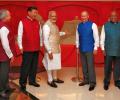
'The crux of the matter is that our narrative lacks credibility with world capitals,' argues Ambassador M K Bhadrakumar.

If China's behaviour in the past on ticklish issues is any indication then China could eventually support India's NSG application, says Rup Narayan Das.

Even senior Indian officials have openly stated that Chinese troops did not enter into the Indian territory, Wang said.

The prime minister, accompanied by senior officials including National Security Advisor Ajit Doval and Foreign Secretary S Jaishankar, met the Chinese leader just before his travel to Myanmar from this port city.

After two decades, the SCO appears to be at a cross-roads with the US withdrawal from Afghanistan, asserts Srikanth Kondapalli, the leading China expert.

Johnson also reiterated his plan to visit India ahead of the G7 summit, after a scheduled visit for Republic Day this month was called off due to the coronavirus crisis.

External Affairs Minister Sushma Swaraj on Monday met her Russian counterpart Sergey Lavrov in Moscow and raised several issues.
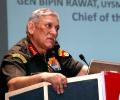
'We should not treat each other as rivals. We should make cooperation the mainstream, China said.

All the three issues raised by China at the Modi-Xi meeting are either intractable or peripheral to the bilateral relations and suggest conventional methods to placate the other side without yielding much, says Srikanth Kondapalli.

Continuing his fast-paced diplomacy, Indian Prime Minister Narendra Modi spoke to China's Premier Li Keqiang on Thursday. During the phone call, Li conveyed his government's desire to establish a robust partnership with the new government in India.
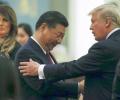
'While many Chinese policy makers dismiss the political, economic and technological component of US-India relations, they express caution on the defence-related ties which also happens to be a major driver in US-India relations,' explains China expert Srikanth Kondapalli.
 © 2026 Rediff.com - Advertise with us - Disclaimer - Privacy Policy - Sitemap - Feedback - About us - Terms of use - Grievances